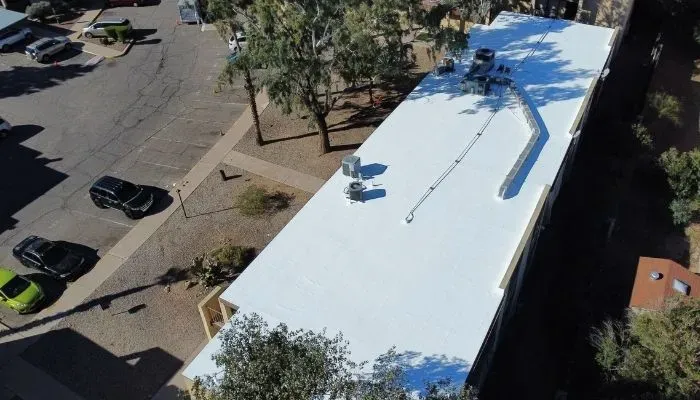
Roof Restoration vs. Roof Replacement: Which Is Right for Your Roof?
If your roof is getting older or starting to have problems, you might assume it’s time to replace it. And sometimes, that really is the best option. But depending on the condition of your existing roof, there may be another way to go about it.
Roof restoration gives property owners the opportunity to repair and reinforce an existing roof instead of removing the entire roofing system and starting over. When the roof is still a good candidate for restoration, this can be a cost-effective alternative to a full replacement.
At MBM Roofing & Coating, we work with existing roofing systems to determine what can be repaired, restored, and protected. We serve Tucson and surrounding Southern Arizona communities, and one of the first things we look at is whether the roof needs to be replaced or if restoration might be a better fit.
So, what’s the difference between roof restoration and roof replacement, and how do you know which one your roof needs? Let’s take a closer look.
What Is Roof Restoration?
Roof restoration is the process of repairing and reinforcing an existing roof to extend its useful life, rather than removing the entire roofing system and installing a new one.
When we evaluate a roof for restoration, we’re looking at what is already there. We want to understand the condition of the roof, what kind of repairs it needs, and whether the existing materials can still serve as a suitable base for a restoration system.
The process can involve preparing the existing surface, repairing damaged areas, adding reinforcement where needed, and finishing with a protective roof coating system. The exact steps depend on the roof and the restoration system being used.
One thing worth understanding is that restoration isn’t simply putting a fresh coat of material over an old roof and hoping for the best. If there are damaged or weak areas, those need to be addressed first. The goal is to repair and strengthen the existing roof before applying the protective coating.
For property owners in Tucson, roof restoration may offer a way to get more life out of an existing roof without going through a complete replacement, provided the roof is in suitable condition.
What Is Roof Replacement?
Roof replacement is a more extensive process. The existing roofing system is removed, and a new roof is installed in its place.
This may be necessary when the roof has deteriorated to the point that it can no longer provide a suitable base for restoration. If the underlying roofing materials are too damaged or the existing system has problems that can’t be adequately addressed through repairs and reinforcement, replacing it may be the better long-term solution.
Of course, replacement also means starting with a new roofing system rather than continuing to work with the one already in place. The amount of work involved will depend on the roof, the materials being removed, and what is needed for the new installation.
At MBM Roofing & Coating, we focus on roof repair, restoration, and coating rather than full roof replacement. Our approach is to evaluate the existing roof and determine whether it can be repaired and restored.
If you’re trying to decide what to do with an aging roof, it’s worth understanding your options before assuming that a complete tear-off is the only answer.
Roof Restoration vs. Roof Replacement: What’s the Difference?
The biggest difference comes down to what happens to your existing roof.
With roof replacement, the existing roofing system is removed and a new one is installed. With roof restoration, the existing roof stays in place while damaged areas are repaired and the system is reinforced and coated when the condition allows.
There are a few other things to consider when comparing the two.
The condition of the existing roof: Restoration depends on having an existing roof that can be repaired and used as the base for a restoration system. If the roof has extensive underlying problems, replacement may be necessary.
The amount of work involved: Replacement involves removing the existing roofing system and installing a new one. Restoration focuses on repairing and reinforcing the roof that’s already there. The work required for either option will depend on the condition of the roof.
The cost: Restoration can be a cost-effective alternative to replacement when the existing roof is suitable for the process. However, the actual cost depends on the roof, the repairs needed, the restoration system, and the scope of the project. It’s important to compare the work each option requires rather than assume one will always be less expensive.
The goal: Both approaches are intended to protect the building, but they get there differently. Replacement gives you a new roofing system, while restoration works to extend the useful life of the existing one.
Neither option is automatically right for every roof. The important thing is figuring out what your roof actually needs before deciding how to move forward.
When Can a Roof Be Restored Instead of Replaced?
This is usually the first question property owners want answered, and understandably so. If you can avoid removing an entire roof, you probably want to know whether that’s a realistic option.
The answer depends on the roof’s current condition.
An older roof isn’t automatically beyond restoration. At the same time, a roof that looks fairly good from the ground may have issues that need to be addressed. Age is one factor, but it isn’t the only thing that matters.
If the existing roof can be repaired and still provides a suitable base for reinforcement and coating, restoration may be an option. This can include roofs with areas of wear, deterioration, or damage that can be addressed without removing the entire roofing system.
The first step is looking at the roof itself. We need to understand what materials are there, what kind of damage has occurred, and whether the existing system can support the restoration approach being considered.
That’s why it’s worth having your roof evaluated before deciding that replacement is your only option. You may have more choices than you realize, but the condition of the existing roof is what helps determine which ones make sense.
When Is Roof Replacement the Better Option?
As much as restoration can help extend the life of an existing roof, it isn’t the right solution for every situation.
If the roof has extensive underlying damage or the existing roofing materials can’t provide a suitable base for reinforcement and coating, restoration may not be appropriate. In those cases, replacement may be necessary.
This is also why it’s important to understand what’s happening beneath the surface. Applying a coating doesn’t correct every roofing problem, and adding reinforcement isn’t going to make every existing roof suitable for restoration.
Think of it this way: if part of a roof needs to be repaired before a protective system can be installed, those repairs need to happen first. If the existing roof can’t be repaired to a condition that supports restoration, another solution may be needed.
The goal isn’t to restore every roof regardless of its condition. It’s to figure out whether restoration is a reasonable option for that particular roof.
At MBM Roofing & Coating, we evaluate existing roofs to determine what can be repaired, reinforced, and protected. That helps property owners better understand their options instead of making a decision based on the roof’s age alone.
Why Does Repair Come Before Roof Coating?
When people hear about roof restoration, they sometimes think it means applying a new coating over the existing roof. Coating is an important part of the process, but restoration can involve quite a bit more than that.
If there are damaged areas, weak spots, or other problems with the existing roof, those issues need to be addressed before the coating is applied.
Think about painting a wall that has water damage. A fresh coat of paint might cover up the marks for a while, but it doesn’t solve the problem underneath. The same general idea applies to roofing. A protective coating isn’t a substitute for repairing problems with the existing system.
With roof restoration, the existing roof is prepared, necessary repairs are completed, and reinforcement is incorporated when the system calls for it. The protective coating is then applied as part of the finished restoration system.
This is an important distinction when comparing restoration with replacement, too. Restoration works with the existing roof, but that doesn’t mean it skips the work needed to prepare and strengthen it.
What Roof Restoration Systems Does MBM Roofing & Coating Use?
MBM Roofing & Coating uses different restoration systems depending on the type and condition of the existing roof. Two of our restoration systems are the Last Bond Roofing System and the Membrane Fiberglass System.
The Last Bond Roofing System is one option for restoring an existing roof. Depending on the condition of the roof, the process can include repairing problem areas, reinforcing the existing system, and applying a protective coating.
The Membrane Fiberglass System uses fiberglass membrane to reinforce the existing roof before the protective coating is applied. The membrane becomes part of the restoration system, providing reinforcement rather than relying on coating alone.
These are two different systems, and the right choice depends on the roof and what it needs. We don’t recommend choosing a system just because the name sounds good or because it worked for another property. The existing roof needs to be evaluated first.
For property owners considering restoration instead of replacement, understanding which systems are available is helpful. It gives you a clearer picture of what restoration can involve beyond simply applying another layer of coating.
How Does the Membrane Fiberglass System Work?
The Membrane Fiberglass System uses fiberglass membrane to reinforce the existing roof before the protective coating is applied.
The roof is first prepared, and any necessary repairs are addressed. The fiberglass membrane is then incorporated into the restoration system, providing additional reinforcement before the protective coating is applied over the restored surface.
One application of this system is shingle roof conversion, which gives qualifying shingle roofs another option to consider before moving straight to a full tear-off.
Rather than automatically removing the existing shingles, we evaluate whether the roof can be used as the base for the restoration process. If the roof is suitable, the Membrane Fiberglass System can be used to create a reinforced, coated roofing system.
This isn’t an option for every shingle roof, of course. The existing roof needs to be evaluated to determine whether the conversion process is appropriate.
Can a Shingle Roof Be Restored Instead of Replaced?
In some cases, yes. A qualifying shingle roof may be converted into a reinforced, coated roofing system using the Membrane Fiberglass System.
At MBM Roofing & Coating, we refer to this application as Shingle Conversion. Instead of assuming that the existing shingles automatically need to be torn off, we evaluate the roof to determine whether it can serve as the base for restoration.
The existing roof is prepared, fiberglass membrane is incorporated as reinforcement, and the protective coating is applied to create the finished roofing system.
It’s worth clarifying that Shingle Conversion isn’t a separate restoration system on its own. It’s an application that uses the Membrane Fiberglass System to restore a qualifying shingle roof.
For homeowners in Tucson and surrounding Southern Arizona communities, this can provide another option when an aging shingle roof needs attention. Whether your roof qualifies depends on its existing condition and whether it can support the restoration process.
What Types of Roofs Can Be Restored?
The type of roof you have is one of the things that determines which restoration options may be available.
Different roofing materials have different requirements, and the kind of damage present can also affect what’s possible. Some roofs may be suitable for one restoration system, while others may need a different approach.
For example, qualifying shingle roofs may be candidates for Shingle Conversion using the Membrane Fiberglass System. Other existing roofs may be better suited to a system such as Last Bond.
The important thing is that there isn’t one restoration system that works the same way for every roof. The existing materials, the condition of the roof, and the repairs needed all play a part in determining what makes sense.
If you’re weighing restoration against replacement, this is where an evaluation can help. Instead of guessing based on the age of your roof or how it looks from the ground, you can get a better understanding of what options may be available for your specific situation.
Does Roof Restoration Cost Less Than Roof Replacement?
Cost is understandably a big part of the decision. Replacing an entire roof is a significant project, so it makes sense to look into whether restoration could be a more affordable alternative.
When a roof is a good candidate for restoration, working with the existing roofing system can avoid the need to remove and replace the entire roof. That can make restoration a cost-effective option, depending on the work involved.
However, the cost difference isn’t the same for every project. A roof that needs substantial repairs and reinforcement will have different requirements from one that is in relatively good condition. The size of the roof, its existing materials, the restoration system used, and the amount of preparation needed can all affect the final cost.
It’s also important not to choose restoration based on price alone. If a roof isn’t suitable for restoration, trying to make it work may not be the right long-term decision.
The best place to start is with an evaluation of the existing roof. Once you understand its condition and what repairs are needed, you can make a more informed decision about the options available.
Roof Restoration in Tucson and Southern Arizona
At MBM Roofing & Coating, we work with existing roofing systems to determine what can be repaired, restored, and protected. We provide roof repair, restoration, and coating services throughout Tucson and surrounding Southern Arizona communities, with commercial roofing services also available in Phoenix.
Our restoration options include the Last Bond Roofing System and the Membrane Fiberglass System. For qualifying shingle roofs, the Membrane Fiberglass System can also be used for Shingle Conversion.
If your roof is showing its age, has areas that need repair, or you’re wondering whether you really need a complete replacement, it’s worth finding out what condition the roof is in first.
Restoration isn’t the right answer for every roof, but it may be an option worth exploring before you commit to replacing the entire system. We’ll evaluate the existing roof and help you understand which restoration options may be suitable for your property.
Frequently Asked Questions
What is the difference between roof restoration and roof replacement?
Roof restoration involves repairing and reinforcing an existing roof, then applying a protective coating system when appropriate. Roof replacement involves removing the existing roofing system and installing a new one. Restoration may be an alternative when the existing roof is still suitable for repair and reinforcement.
Is roof restoration cheaper than roof replacement?
Roof restoration can be a cost-effective alternative when the existing roof is suitable for the process. The actual cost depends on the roof’s condition, the repairs needed, and the restoration system being installed. An evaluation can help determine what work is required.
How do I know if my roof can be restored?
The best way to find out is to have the existing roof evaluated. Its age, roofing materials, extent of damage, and overall condition all help determine whether restoration is appropriate. Not every roof qualifies, but an older roof doesn’t automatically need to be replaced.
Can MBM Roofing & Coating replace my roof?
MBM Roofing & Coating focuses on roof repair, restoration, and coating rather than full roof replacement. We evaluate existing roofing systems to determine whether they can be repaired and restored using an appropriate restoration system.
What is the Membrane Fiberglass System?
The Membrane Fiberglass System is a roof restoration system that uses fiberglass membrane to reinforce an existing roof before a protective coating is applied. It can also be used for Shingle Conversion on qualifying shingle roofs.
What is the Last Bond Roofing System?
The Last Bond Roofing System is one of MBM Roofing & Coating’s restoration systems for existing roofs. Depending on the condition of the roof, the process can involve repairing problem areas, reinforcing the existing system, and applying a protective coating.
Can shingles be restored instead of replaced?
Some shingle roofs may qualify for Shingle Conversion using the Membrane Fiberglass System. The existing roof is evaluated first to determine whether it can support the restoration process. If it qualifies, the system can provide an alternative to removing the entire shingle roof.
Does every roof qualify for restoration?
No. A roof needs to be in a condition where it can be properly repaired and used as the base for a restoration system. If there is extensive underlying damage or the existing roofing materials aren’t suitable, restoration may not be appropriate.
Where does MBM Roofing & Coating provide roof restoration services?
MBM Roofing & Coating is based in Tucson and serves surrounding Southern Arizona communities, as well as Phoenix for commercial roofing projects. We provide roof repair, restoration, and coating services for existing roofing systems, including the Last Bond Roofing System, Membrane Fiberglass System, and Shingle Conversion.